
The Axis Report: Ground Zero for the Pink Pill— Inside Turning Point USA’s Women’s Leadership Summit
Newsletter + The Longform Interview


Contents:
Read and Watch: The Interview
Podshots: This Week on SWAJ
Watch: YouTube Clip of the Week
Network: What’s Happening at Axis Mundi Media
Reasons for Hope
The Spotlight: People, Organizations, and Events You Should Know About
SWAJerati: What We Are Reading
SWAJJER: Discord Comment of the Week
Shoutouts: Welcoming New Members
Read: The Interview (cont.)
Read: The Interview
Ground Zero for the Pink Pill: Inside Turning Point USA’s Women’s Leadership Summit
An interview between Annika Brockschmidt and Madeleine Peltz
The Conference and the Audience
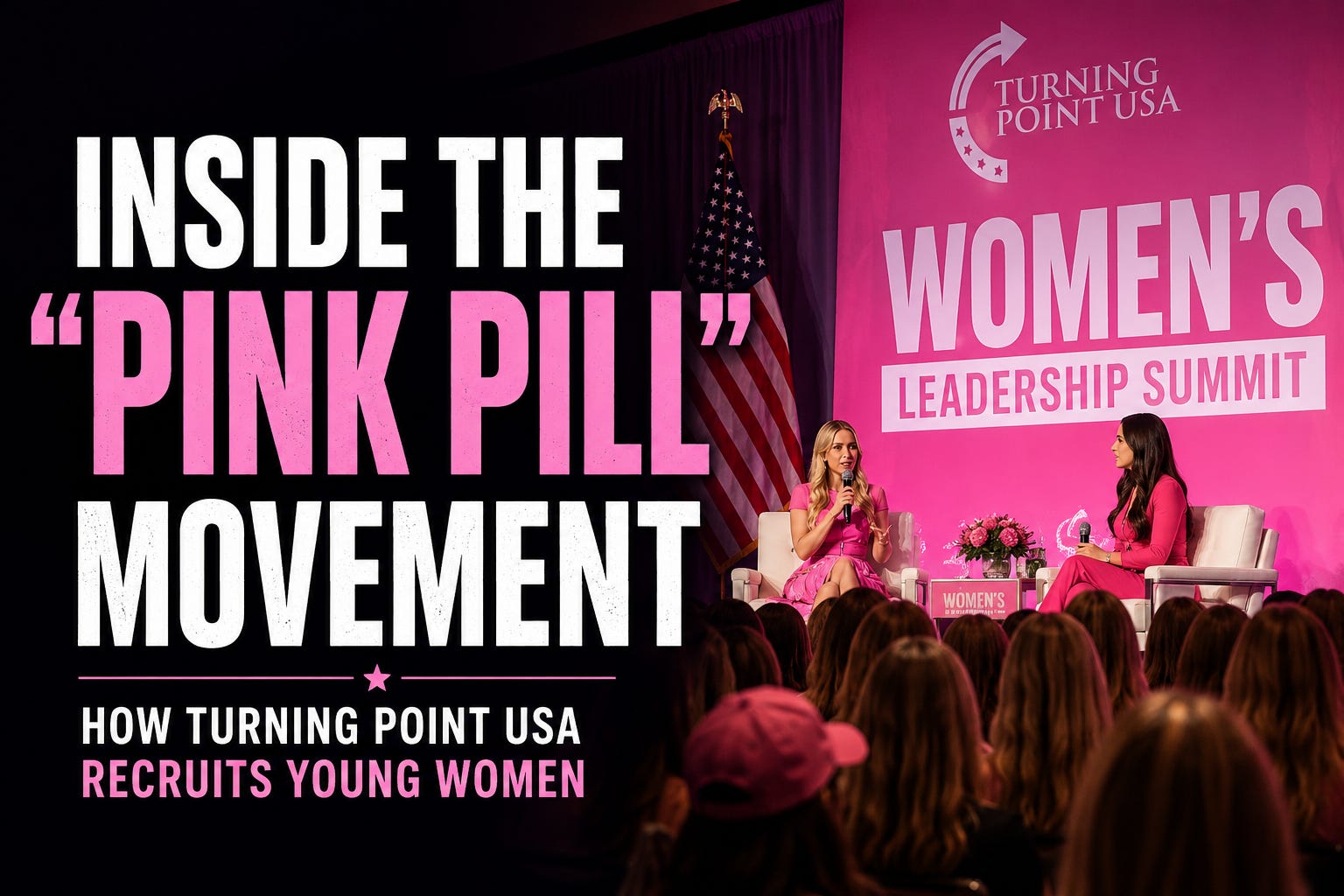
Annika Brockschmidt: You’ve been covering the youth movement wing of the U.S. far right for years, and you’ve clocked a lot of hours at Turning Point USA events. Recently, Turning Point held one of its infamous Women’s Leadership Summits—an event you’ve called “ground zero for the pink pill movement.” What do you mean by that? Who goes to these events?
Madeleine Peltz: The Women’s Leadership Summit has been going on for over a decade now. It’s one of Turning Point USA’s flagship events. Every year in Texas, they gather between 2,000 and 3,000 young women and give them a slate of talks from their favorite right-wing media celebrities.
In the last couple of years, the space targeting young women in right-wing media has really expanded. What you see are commentators who blend pop culture, lifestyle, wellness, and politics to recruit young women who otherwise wouldn’t be interested in right-wing politics—especially Trump. Trump isn’t exactly a natural fit for Gen Z women.
What these events do is give young women an opportunity to network, meet each other, meet their favorite right-wing media celebrities, and become more deeply embedded in the movement.
Brockschmidt: The name itself—Women’s Leadership Summit—seems surprising given how many speakers push women’s submission and “biblical womanhood.” Is the branding just a leftover from Turning Point’s earlier libertarian phase, or is it part of a larger strategy?
Peltz: It’s partly a leftover. Charlie Kirk originally embraced a much more “girl boss” rhetoric. You’d hear him say things like, “We’ve maybe got the first female president in the room today,” or, “If you want to be a mom, that’s great. If you want to be a businesswoman, that’s awesome.”
During the first Trump administration, they heavily touted female leadership figures like Kellyanne Conway and Sarah Huckabee Sanders. But Charlie Kirk went through a political and spiritual transformation in 2021 under the tutelage of Pastor Rob McCoy. After that, you see a major shift toward biblical submission and finding a husband. That became the primary message.
One year I was at the conference and some men at the hotel heard us say we were covering the Women’s Leadership Summit. They said, “Oh, I’d love to send my daughter to something like this.” We had to tell them: no, this isn’t what you think it is.
Brockschmidt: What’s the age range of attendees?
Peltz: You’re talking about girls as young as high school age. Turning Point has expanded aggressively into high schools, building chapters around the country. They actively recruit through field representatives—essentially entry-level organizing jobs for recent graduates.
Many young women have told me that Turning Point helps with travel and accommodations. One young woman said a field representative messaged every woman following her university’s Young Republicans account and offered to pay for them to attend if they started a Turning Point chapter on campus.
So yes, there is very active recruitment.
Brockschmidt: Has attendance grown?
Peltz: Definitely. The first event in 2015 drew roughly 150 students. Now it’s between 2,000 and 3,000 attendees annually.
It’s important not to overstate how conservative Gen Z is. The vast majority of Gen Z women are progressive, and there’s a tremendous divide between young men drifting right and young women moving further left.
But the margins matter. The shift among young voters toward Trump in 2024 may have been one of the most consequential electoral shifts. These changes happen over decades, not months.
The Interview continues at the end of the post…
Podshots: What’s Happening on SWAJ
The Sunday Interview: Inside the Pink Pill Movement
Tuesday: Axis Live - with Brad Onishi and Matthew Taylor

Wednesday: It’s In the Code

Friday: The Weekly Roundup - Live!

Watch: YouTube Clip of the Week
Network: What’s Happening at Axis Mundi Media
Big news: Beginning June 16, we’re launching two new ways to stay informed and connected with the stories shaping religion, politics, and public life.
The Axis Daily Brief is a weekday morning roundup designed to help you make sense of the news before the day gets away from you. Every weekday, a rotating team of Axis Mundi contributors—including Brad Onishi, Matthew Taylor, Angela Denker, Dan Miller, Holly Fletcher, and others—will deliver concise analysis of the stories, trends, and developments that matter most. Think of it as your daily guide to the intersection of religion, democracy, culture, and power.

Listen to the Axis Daily Brief:
Axis Daily Brief on Apple Podcasts:
Axis Daily Brief on Spotify:
Axis Daily Brief RSS Feed: https://api.substack.com/feed/podcast/1145852/s/400220.rss Available on Apple Podcasts, Spotify, and wherever you get your podcasts.
We’re also launching Axis Live, a new live-streamed conversation series featuring Brad Onishi, Matthew Taylor, and special guests from across journalism, scholarship, and public life. Axis Live will give us a chance to respond in real time to breaking news, answer your questions, and build a deeper community around the issues we cover every day.

These launches represent the next step for Axis Mundi Media. Our mission has always been to provide rigorous analysis, public scholarship, and independent journalism about religion and politics in America. With the Daily Brief and Axis Live, we’ll be able to bring you more timely coverage while continuing the in-depth reporting, interviews, and podcasts you’ve come to expect.
Reasons for Hope:
Satirical news outlet The Onion has announced that it will officially launch its InfoWars website on July 2—with or without legal permission—so that it can move forward with plans to pay the families of Sandy Hook victims an initial $100,000.
In other payout news, NPR recently reported that many of the 600+ people known to have been fired over comments made in the wake of Charlie Kirks death are receiving massive payouts because of their wrongful terminations.
International pop-star Dua Lipa is using her fame for good and recently opened The Manifesto Library in Porto, Portugal. The collection focuses on banned books and is intended to serve “as a living cultural space for reading, debate and public reflection.”
The Spotlight: People, Organizations, and Events You Should Know About

You may have heard the awful news about the 22 people facing decades in prison for protesting at the Prairieland ICE detention facility (more info is available here). Over on the SWAJ Discord, Dawson Fisher brought our attention to a fundraiser for the Prairieland defendants. You can purchase a packet of the zines “used as evidence in the Texas trial touted by the federal government as the first case against ‘antifa.’”
SWAJJER: Discord Comment of the Week
Brian: Fucking hell. SCOTUS rules that refugees showing up at a port of entry seeking asylum haven’t entered the country yet and therefore their case doesn’t have to be considered. So cross the border illegally and seek asylum? Shouldn’t have crossed illegally. Show up at a port of entry? Well you’re not in the country yet: https://www.scotusblog.com/2026/06/justices-side-with-trump-administration-in-border-dispute-over-asylum-seekers/
Shoutouts: Welcoming New Members
Thank you to Sean T., George C., and the 4,000 others who made the switch with us from Substack over to Supercast!
Read: The Interview (cont.)
An interview between Annika Brockschmidt and Madeleine Peltz
Evangelical Culture in Pink
Brockschmidt: Who’s the archetypal attendee?
Peltz: Mostly young women from religious conservative households. They’re overwhelmingly white, though not entirely. There’s actually more diversity than many people expect. When I was on the ground, all these girls suddenly got up and started doing a line dance to the song “Church Clap”—something they all knew from evangelical megachurch culture. Turning Point deliberately mimics that environment. It makes attendees feel at home.
Brockschmidt: The aesthetics are fascinating. There’s so much pink, gingham, cowboy boots, “too cute to cancel” branding. What visual language are they using?
Peltz: The aesthetics are deliberately unserious. One thing people don’t fully understand about this conference is that there is essentially no discussion of current events. Every year I’ve attended, something huge has been happening politically, and it’s simply not acknowledged. Instead, speakers tell young women how to find a husband, how to have a “God-honoring single season.” That’s a phrase you hear constantly.
The idea of the “single season” suggests that being unmarried is a temporary state of diminished existence. You’re supposed to cope by reading your Bible and making yourself as attractive as possible until marriage eventually arrives.
Brockschmidt: That’s incredibly dark.
Peltz: It is. The conference is heavily themed. In 2022 the aesthetic was almost Hot Topic emo. In 2023 it was disco-themed—”taking back the ‘70s” from feminism. More recently we’ve seen a turn toward tradwife aesthetics, which I think accelerated after Dobbs. This year’s theme was “Curated for HER”—HER standing for “holistic, empowered, redeemed”—which references both religion and the MAHA movement.
Politics, Voting, and Contradictions
Brockschmidt: One slogan you’ve documented is “Recruit, Train, Elect.” What political role does Turning Point envision for young women—especially when some speakers now openly advocate repealing the Nineteenth Amendment?
Peltz: It’s an unresolved tension. On one hand, for the conservative project to succeed, many figures argue women should retreat from public life. On the other hand, conservatives can’t win elections without women voting.
Turning Point has extremely close ties to the Republican National Committee. During the last cycle, the RNC outsourced large portions of its field operation to Turning Point. Students become door-knockers, phone bankers, field representatives. In many ways, Turning Point is also a jobs program. So they absolutely need young women politically, even while parts of the movement question women’s political participation.
The Post-Charlie Kirk Era
Brockschmidt: Since Charlie Kirk’s death, Turning Point seems to be struggling to find its footing. Erika Kirk has stepped into leadership, but it’s been an awkward transition. How would you characterize it?
Peltz: Turning Point is unquestionably in crisis, and what happens next will tell us a lot about the future of Gen Z conservatism. Erika embodies a fundamental contradiction. On one hand, she’s a grieving widow—the ultimate victim, in movement terms. That’s not someone people feel comfortable challenging.
On the other hand, she’s now CEO of Turning Point USA. CEOs don’t get immunity from criticism or heckling. The problem is that she didn’t sign up to be the CEO. She signed up to be the wife. Charlie was irreplaceable. He raised nearly half a billion dollars over the course of his career and cultivated intensely personal relationships with donors, many of whom viewed him almost as a son. Those relationships cannot simply be transferred.
Internal Fractures and Public Drama
Brockschmidt: The conference this year featured a dramatic heckling incident. What happened?
Peltz: During Erika Kirk’s speech, a young woman stood up and shouted, “Erika Kirk protects pedophiles.” Erika was deeply shaken and cried through the remainder of her remarks. The woman later told reporters she was speaking from a liberal perspective, referring to the Trump administration and the Epstein files. But interestingly, someone on the conspiratorial right could easily have said exactly the same thing and meant something entirely different. That’s because Erika is also being targeted by an ongoing conspiracy campaign led by Candace Owens, who was once one of Charlie Kirk’s closest allies. The amount of pressure and hostility surrounding Erika right now is extraordinary.
MAHA, Wellness, and the Pink Pill
Brockschmidt: Talk to me about the overlap between Turning Point, the religious right, and the Make America Healthy Again movement.
Peltz: The Women’s Leadership Summit has become a major convergence point where the religious right, anti-feminist politics, and MAHA all intersect. MAHA itself is a surprisingly diverse coalition. At rallies I’ve spoken to anti-vaccine activists, environmentalists, consumer advocates, even leftists.
The key conduit bringing MAHA into Turning Point is Alex Clark. Alex believes hormonal birth control contributed to her autoimmune problems and that getting off birth control, combined with healthier living, improved her health. Those concerns resonate with many women. The broader issue is that MAHA speaks to genuine dissatisfaction with corporate healthcare and women’s medical experiences. The right has become very effective at absorbing those concerns rather than gatekeeping them.
Alex Clark and the Politics of Singleness
Brockschmidt: Alex Clark recently announced her engagement at the summit after years of discussing singleness publicly. How was that received?
Peltz: Extremely well. These young women have followed Alex’s journey for years. She joked, “Our long national nightmare is over. I have a fiancé.”
People were genuinely happy for her. Online, however, things became much uglier. Critics dug up videos of her fiancé and questioned his masculinity. Candace Owens amplified some of that content. Alex fired back aggressively, which highlights another contradiction in this world. She has a genuinely mean edge that doesn’t fit neatly with the “keep sweet” rhetoric promoted by many trad influencers.
Ultimately, the realities of being a woman in your thirties are complicated, and Turning Point overlays an extremely simplified message that often doesn’t reflect the lives of the people preaching it.
The New Influencers
Brockschmidt: One of the fastest-rising figures in this ecosystem is Savannah Faith Stone, a 20-year-old influencer who advocates repealing the Nineteenth Amendment and denies the existence of consent within marriage. What’s her business model?
Peltz: Savannah had a very rapid rise. She was an aspiring actress and pageant contestant. What worked for her was right-wing rage bait.
You see many twenty-year-old tradwives online. You don’t see many fifty-year-old tradwives. That’s because it’s not a particularly sustainable model. There’s also a sexual suggestiveness beneath much of this content. Public performances of submission have obvious erotic undertones.
Real wives are often working-class women trying to make life work economically. Single-income households are increasingly unrealistic for most Americans. Whether this model remains viable long-term, I don’t know.
Listening to Conservative Young Women
Brockschmidt: Some young women at the conference said they’d willingly give up their right to vote if it meant ending abortion. How should we understand that?
Peltz: Conservative young women are often poorly understood. Polling consistently shows that their priorities are actually much closer to liberal young women than to conservative young men. They value marriage, certainly, but they also value work-life balance and professional aspirations. I think we do a disservice when we flatten them into stereotypes. Many push back. I’ve repeatedly watched young women challenge Charlie Kirk directly during Q&A sessions.
In 2025, I interviewed three women from the same family—a mother, daughter, and aunt. They strongly disapproved of Charlie’s advice encouraging women to pursue an “MRS degree.” They thought it was strange and unrealistic.
Young people want to be heard. There’s an enormous difference between covering the audience and covering the people on stage. And that’s where my work will continue to focus: understanding what these young conservatives actually believe, and where the movement goes next.
The Interview has been edited for length and clarity.
 | A guest post by
|